
Addition of H-Br to an Alkene
Updated: Oct 7
When examining addition reactions of alkenes, the resulting products can be categorized as either Markovnikov or anti-Markovnikov. The term Markovnikov is named after the Russian chemist Vladimir Markovnikov, who formulated the Markovnikov Rule. This rule indicates where an addition will occur on the molecule, thus describing the molecule's regiochemistry. Simply put, the Markovnikov rule states that the carbocation will form on the more substituted carbon. Consequently, this rule focuses on carbocation stability.
One classic example that details this scenario is the addition of H-B to an alkene. The reason starts by the alkene pi electrons attacking the electrophilic hydrogen of the H-Br. Now, since a bond is broken, the carbon that did not get the hydrogen is lacking an octet and has a positive charge. The Markovnikov rule tells us where that charge is located on the molecule.
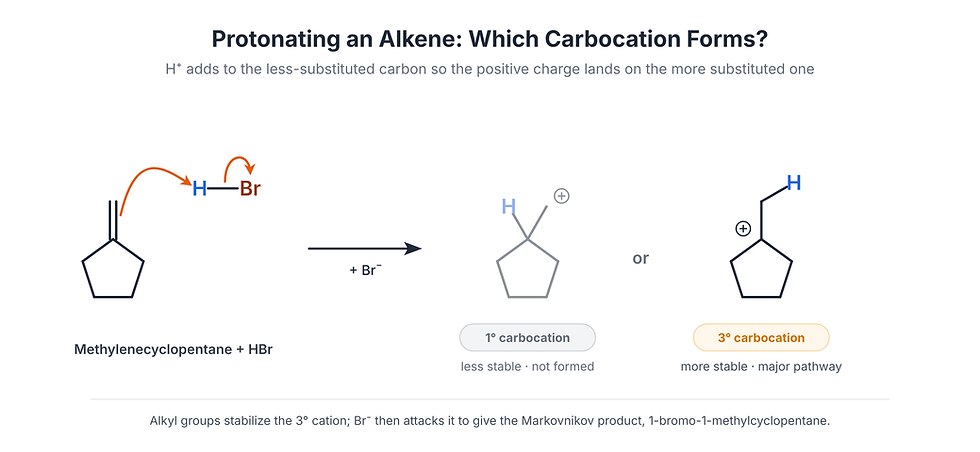
In the above picture, we can see that there is a choice of where the hydrogen must go and a choice as to what carbocation will form. Applying Markovnikov's rule, tells us that the carbocation will be on the more substituted carbon. You can also think of this as "the rich get richer" as the hydrogen goes where there are more H's. The more stable tertiary carbocation is preferentially formed and leads to product formation.

Many other reagents act in what is called "Markovnikov fashion" meaning that they add to the more hindered side of an alkene. Some reagents, can add in what is referred to as "Anti-Markovnikov fashion" in that they add to the least hindered side of an alkene. Make sure you remember which reagents add Markovnikov and which add anti-Markovnikov!

Comments