
The Apron That Vanished: How Guncotton Was Discovered
A spill in the kitchen: the discovery of guncotton
In 1845, a chemistry professor in Basel, Switzerland, did something every chemist has been told never to do: he ran an experiment in the family kitchen. His wife had forbidden it. She was out.
As the story goes, Christian Friedrich Schönbein was working with a mixture of nitric and sulfuric acids when the flask cracked and the liquid spread across the table. He grabbed the nearest thing that would soak it up, his wife's cotton apron. He mopped up the mess, rinsed the apron, and hung it near the hot stove to dry before anyone came home.
A few minutes later the apron was gone. There was no smoldering and no smoky flame, only a sudden bright flash, and then nothing at all. No ash was left on the hook.
Historians are not sure the apron story is literally true; it may have been polished over many retellings. But the chemistry in it is real, and so is what Schönbein did next. He did not throw the idea away. He went looking for it on purpose.

The man who smelled ozone
Schönbein was no amateur. Born in Germany in 1799, he spent most of his career as a professor at the University of Basel. A few years earlier he had already made his name by noticing a strange, sharp smell near electrical equipment. He named the gas behind it ozone, after the Greek word for "to smell."
So when cotton vanished in a flash, he recognized that he had made a new substance, not just set fire to a rag. Ordinary cotton burns slowly and leaves ash. This material burned almost instantly, left essentially no residue, and made very little smoke.
In 1846 he announced his "Schiessbaumwolle," or shooting cotton. In English it quickly became guncotton. In the same year Rudolf Böttger, a chemist in Frankfurt, found the same material independently. The two men chose to cooperate rather than fight over credit.
He was not the first to glimpse the effect. In the 1830s Henri Braconnot and Théophile-Jules Pelouze had treated starch and paper with nitric acid and gotten a powder that burned in a flash. Schönbein's nitrated cotton went much further: an 1889 account says he announced it as having four times the power of gunpowder.
A miracle that kept exploding
In the 1840s armies ran on black powder, a mixture of charcoal, sulfur and saltpeter that had barely changed in centuries. It fouled gun barrels and covered battlefields in thick white smoke. Guncotton promised more power with almost no smoke. Military officials across Europe took notice immediately.
Schönbein demonstrated his cotton in England in 1846 and sold the British rights. John Hall and Son, a gunpowder maker in Faversham, Kent, began manufacturing it at its Marsh Works. On 14 July 1847 the factory blew up, killing some twenty people. France and other countries had similar accidents. One by one, most governments gave up on the material.
Austria held on longest. An Austrian officer, Captain Wilhelm von Lenk, refined the manufacturing process. In 1853 Austria opened the first purpose-built guncotton factory, at Hirtenberg. Then two magazines full of guncotton blew up, for reasons no one could explain at the time, and in 1865 Austria dropped it from service. Guncotton now had a reputation: astonishing when it worked, and liable to decompose and explode in storage.
The problem was purity
The answer came from Frederick Abel, chief chemist at Britain's Royal Arsenal in Woolwich. In the mid-1860s he figured out why guncotton kept destroying the buildings it was stored in.
The culprit was leftover acid. Traces of acid trapped inside the hollow cotton fibers slowly broke the material down. That breakdown released more acid and heat, which sped up the decomposition further, a runaway cycle that could end in an explosion.
Abel's fix, patented in 1865, was simple in principle. He chopped the cotton into a fine pulp so that no acid could hide in the fibers, then washed it thoroughly until it was clean and stable. The pulp could also be pressed into dense blocks that were far safer to handle. Twenty years after the apron, guncotton finally became a practical material.

From bandages to billiard balls to the movies
The most lasting legacy of Schönbein's discovery was not the explosive. Less heavily nitrated forms of the same material, made from the same cotton, turned out to be enormously useful, and they launched the age of plastics.
Year | Development | Why it mattered |
1847 | Collodion used as a liquid wound dressing | Dissolved nitrocellulose dried into a protective film on the skin |
1851 | Frederick Scott Archer's wet collodion photography | Sharp glass-plate photographs became cheap and common |
1862 | Alexander Parkes shows Parkesine in London | One of the first human-made plastics |
1870 | The Hyatt brothers patent celluloid | Replaced ivory in billiard balls, combs and piano keys |
1884 | Paul Vieille's Poudre B in France | The first practical smokeless gunpowder |
1889 | Abel and James Dewar develop cordite | Britain's smokeless propellant for decades |
1889 | Celluloid roll film for cameras | Made motion pictures possible |
Nitrate film had a dark side of its own: it was highly flammable, and fires in projection booths and film vaults destroyed many early movies. Celluloid lasted longest in a surprising place. Table tennis balls were made of it until 2014, when the sport switched to a non-flammable plastic.
What actually happened to the apron
Cotton is almost pure cellulose, a long chain of glucose units. Each unit carries three hydroxyl (–OH) groups. The acid mixture converted many of those –OH groups into nitrate esters (–ONO₂). Sulfuric acid's job was to drive the reaction forward by activating the nitric acid and soaking up the water formed.
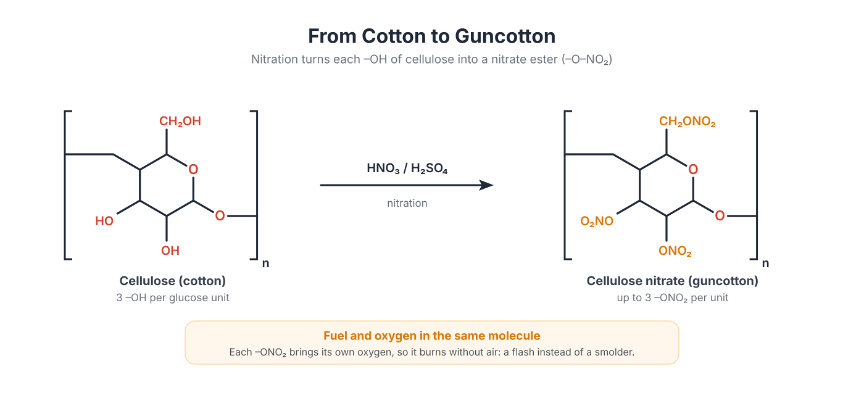
The name "nitrocellulose" is a small misnomer, a nice point for organic chemistry students. The nitrogen is attached through oxygen, so the compound is a nitrate ester, not a true nitro compound with a C–NO₂ bond.
That structural change explains the flash. Normal cotton has to pull oxygen from the air to burn. Nitrated cotton carries its own oxygen built into every unit of the chain, so once ignited it can turn almost entirely into hot gases (CO₂, CO, N₂ and water vapor) in an instant. The amount of nitration decides what you get. Lightly nitrated material became collodion and celluloid; heavily nitrated material became guncotton.
The broader lesson is one every chemistry student learns eventually. Making a new compound is often the easy part. Schönbein's discovery took one accident, but making it safe took twenty years and a chemist who asked why it kept failing. Many of the most important advances in chemistry come down to purification and stability.
Sources
• Gun-Cotton: Its History, Manufacture, and Use, U.S. Naval Institute Proceedings, July 1889. Supports the 1846 announcement, Böttger's parallel work, the earlier Braconnot and Pelouze observations, von Lenk and Hirtenberg (1853), Austria's 1865 abandonment and Abel's 1865 process.
• The Marsh Gunpowder Works (guncotton factory), Faversham, Kent Historic Environment Record. Supports John Hall and Son's guncotton patent and the 14 July 1847 explosion that killed some 20 people.


Comments