
Addition to Ketones and Aldehydes: Imine and Enamine Formation Part 1
Updated: Oct 6
Aldehydes and ketones undergo addition at the carbonyl carbon. Depending on the nucleophile, a direct addition at the carbonyl carbon can occur (usually strong nucleophiles that are charged) or the carbonyl can be "activated" prior to addition (usually with weak, uncharged nucleophiles) to increase the electrophilicity of functional group. For imine and enamine formation, we will need to activate the carbonyl since we are going to be adding uncharged amines.
Take a look at the overall general scheme below.
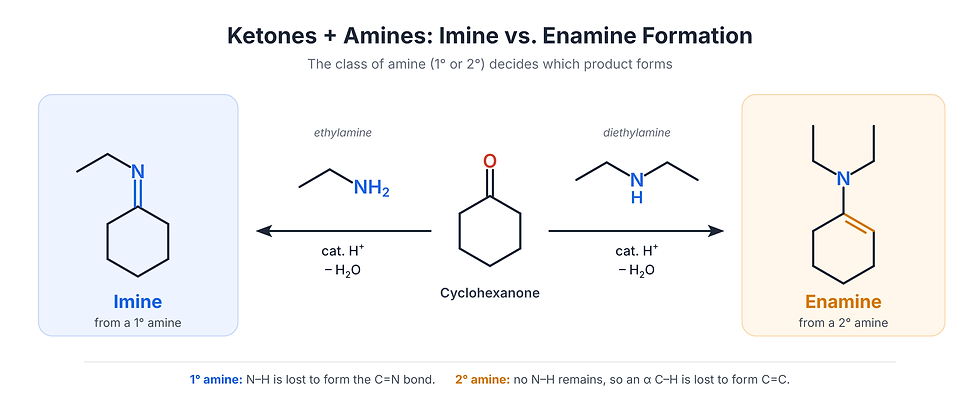
From the scheme above, we can see that in the presence of an acid catalyst, either a primary amine or a secondary amine can add to a carbonyl to form an imine or an enamine, respectively. Importantly, tertiary amines do not react and are considered to be non-nucleophilic bases. Note, that a molecule of water is lost in this reaction (this will be important later). Now, let's take a dive into the mechanism and see what is happening. We will look at using ketones for imine formation first and then enamine formation in part 2.
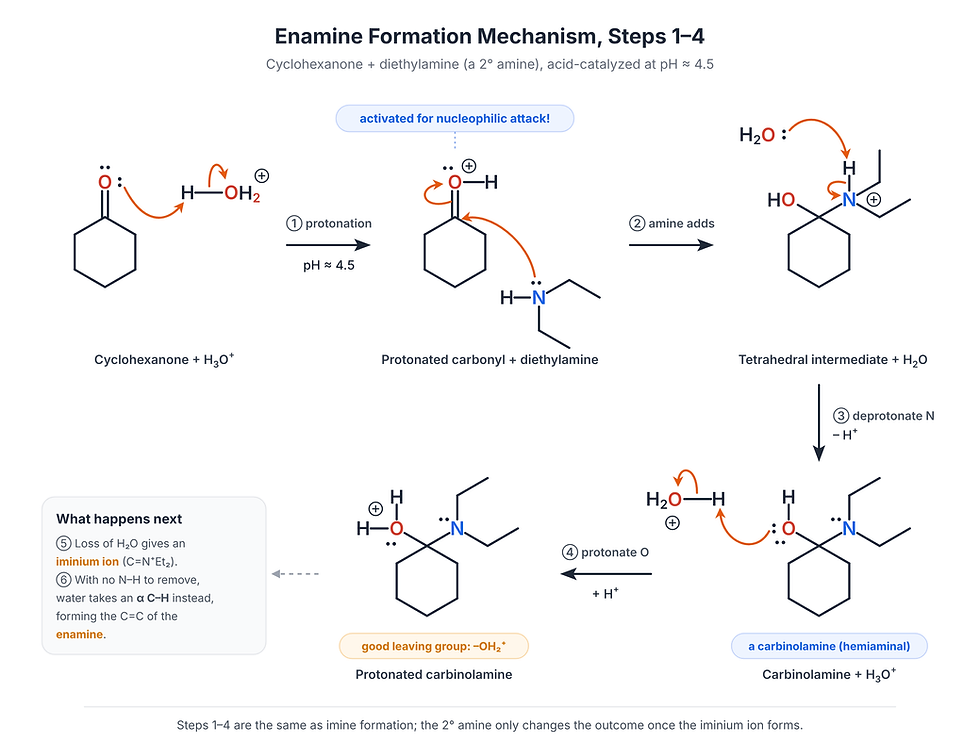
In the first step of imine formation , the carbonyl is "activated" by using an acid. There, however, is a caveat to this step; too much acid will protonate the amines (they are bases!) and will render them useless. Therefore, it turns out that the optimal pH for this reaction to occur is at about 4.5. Once the carbonyl is activated, the primary amine can attack the carbonyl.

Once the nucleophilic attack by the amine has occurred, the next steps are a sereies of proton transfer steps. Here is a good point in the mechanism to discuss the reaction equilibrium. The entire reaction is in equilibrium. During the subsequent steps, an intermediate referred to as a "carbinolamine" (this is also called a hemiaminal) is formed. At this point, the alcohol needs to be protonated so the reaction can progress (to form a good leaving group, water) but the amine is actually more basic than the alcohol. So, the amine can get protonated by the acid but that just leads backwards to where you started from. In order to drive the equilibrium, one can remove water and push the reaction in the forward direction according to Le Chatlier's principle. Small amounts of the carbinol amine alcohol will get protonated and the reaction can proceed.

The final steps in the reaction are removal of the leaving group and deprotonation of the recently formed iminium ion. Here, it is important to note that the reason it is necessary for solvent to act as a proton shuttle because remember that the molecule is 3D. It make look like it would be easy on paper (or in this case on a screen), but in reality since the molecule is not flat, that is not the case. It would almost be like trying to lick the back side of your elbow, something that is difficult to do unless you are perhaps a contortionist.

To summarize, imine formation begins with activating the carbonyl using an acid, but caution is needed to avoid protonating the amines, as this would render them ineffective. The optimal pH for this reaction is about 4.5. Once activated, the primary amine can attack the carbonyl. Following the nucleophilic attack, a series of proton transfer steps occur, creating a carbinolamine intermediate. To drive the reaction forward, water must be removed, as the reaction is in equilibrium. The final steps involve removing the leaving group and deprotonating the iminium ion, with the solvent acting as a proton shuttle due to the molecule's three-dimensional structure.


Comments