
Addition to Ketones and Aldehydes: Imine and Enamine Formation Part 2
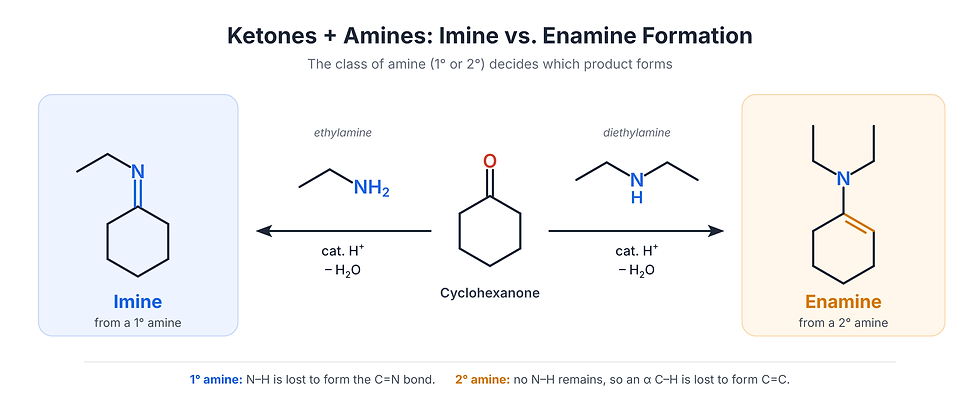
In a previous post, we saw that a primary amine can add to a ketone or an aldehyde to form an imine. We noted that there are some stringent conditions regarding the acid catalyst (pH = 4.5) and the removal of water to drive the equilibrium forward. In this post, we will look at what happens when we use the same conditions but this time, with a secondary amine. Remember, tertiary amines do not react. Importantly, enamines will be used for subsequent reactions in organic chemistry, so it is a good idea to understand how they are formed and also, how they are hydrolyzed.
The reaction will begin in the same way as in imine formation, protonation of the carbonyl to "activate" it towards nucleophilic attack. Once the secondary amine attacks the carbonyl, a series of proton transfer steps occur. Take a look below and see the key steps that are identical to imine formation.
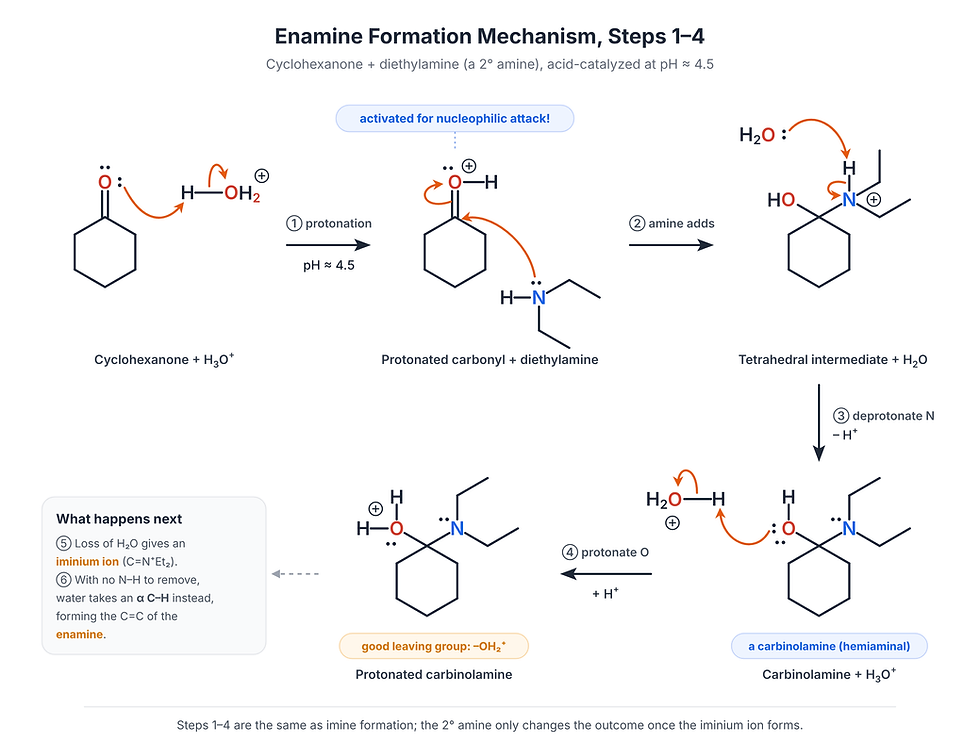
Now, notice the last box labeled "What happens next." The next step is the key difference between imine and enamine formation. Since we only have one hydrogen on the nitrogen as seen in step 2, there is no way to remove the imininium ion. Another step must now happen, double bond formation. Take a look below.
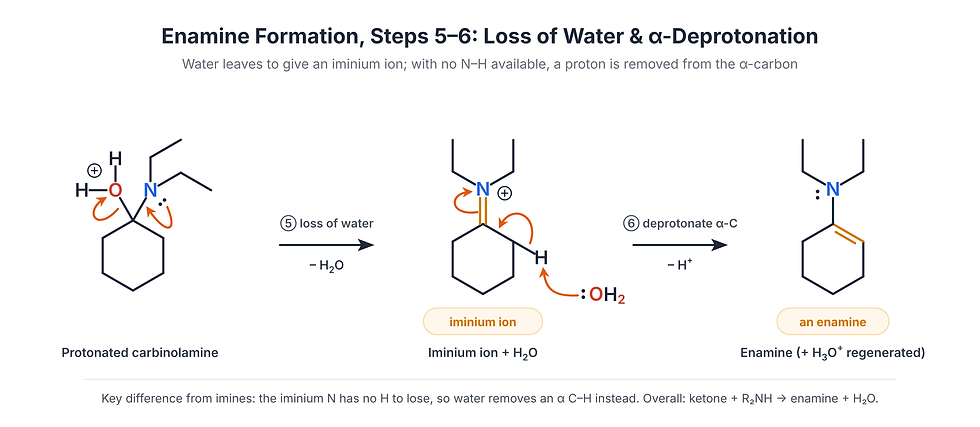
Now, that we have covered both imine and enamine formation, a future post will show the utility of enamines and how we hydrolyze them. That's all for now, check back for new updates soon!
Comments