
Thalidomide: When Mirror Images Matter
A sedative that changed drug law, the case of thalidomide
Thalidomide is the textbook example of why stereochemistry matters in medicine — and also a case where the textbook version is too simple. A single stereocenter, an acidic C–H bond, and a protein target nobody knew about until 2010 together explain one of the worst drug disasters of the twentieth century.
The West German company Chemie Grünenthal launched thalidomide in 1957 as a non-barbiturate sedative, sold over the counter as Contergan. It seemed remarkably safe: overdoses were rarely fatal. Doctors in dozens of countries soon prescribed it for anxiety, insomnia and morning sickness in pregnancy.
By 1961, physicians including Widukind Lenz in Germany and William McBride in Australia had linked the drug to a wave of severe birth defects, especially phocomelia (shortened or absent limbs), along with damage to the eyes, ears, heart and internal organs. Roughly 10,000 children were affected worldwide, and many more pregnancies ended in miscarriage. The drug was withdrawn in late 1961.
The United States was largely spared because FDA reviewer Frances Oldham Kelsey refused to approve the application, repeatedly asking the manufacturer for more safety data. The disaster led directly to the 1962 Kefauver–Harris Amendments, which required proof of efficacy and much stronger safety testing before approval.
One stereocenter, two enantiomers
Thalidomide has a single stereocenter: C3 of the glutarimide ring (marked with an asterisk below), which carries the phthalimide nitrogen, the C2 carbonyl carbon, the C4 methylene and a hydrogen. Because those four groups are all different, the molecule is chiral and exists as two non-superimposable mirror images.

Assigning the configuration is a good Cahn–Ingold–Prelog exercise:
1. N (phthalimide) — highest atomic number attached to C3.
2. C2 — a carbonyl carbon, substituents (O, O, N).
3. C4 — a methylene, substituents (C, H, H).
4. H — lowest priority, pointing away from the viewer.
In the right-hand structure, tracing N → C2 → C4 runs clockwise, so it is (R). Its mirror image runs counterclockwise and is (S). Thalidomide was sold as the racemate: a 1:1 mixture of both.
The textbook story: a "good" and a "bad" enantiomer
The version most of us learned goes like this: (R)-thalidomide is the sedative, (S)-thalidomide is the teratogen, and if only the drug had been sold as pure (R), the tragedy would never have happened.
There is real chemistry behind the first half. Enzymes and receptors are themselves chiral, so two enantiomers can bind them very differently — the same way a right hand fits a right-handed glove but not a left one. A 1979 study by Blaschke and co-workers in mice reported that the (S)-enantiomer and its metabolites were responsible for the fetal toxicity, while sedation was associated mainly with (R). Later work on the protein target (below) also shows that (S) binds more tightly.
The second half of the story — that pure (R) would have been safe — does not hold up. Animal results were never clean (a 1967 rabbit study found both enantiomers teratogenic), and, more fundamentally, the stereocenter does not stay put in the body.
Why a single enantiomer would not have helped: racemization
Thalidomide's enantiomers interconvert in the body within hours, so giving a patient pure (R) soon produces a mixture of (R) and (S) anyway.
The culprit is the hydrogen on the stereocenter (circled in Figure 2). That C–H sits alpha to the C2 imide carbonyl, and the carbon also bears the electron-withdrawing phthalimide nitrogen. Both make the proton unusually acidic for a C–H bond. At physiological pH, and with help from basic residues on proteins such as serum albumin, the proton is removed to give an enolate, which is protonated on oxygen to form the enol.
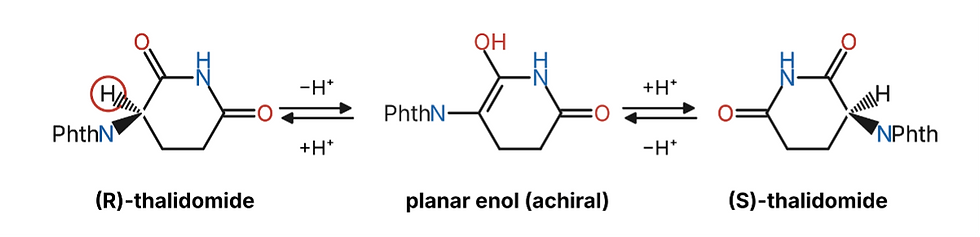
In the enol, C3 is sp² hybridized and trigonal planar, so the stereocenter is gone and the intermediate is achiral. When C3 is re-protonated, the proton can arrive from either face of the planar double bond with equal probability. Attack from one face regenerates (R); attack from the other gives (S). Run this equilibrium long enough and any starting enantiomer becomes a racemate.
This is the same chemistry students meet when they learn that a stereocenter alpha to a carbonyl racemizes under acid or base. Thalidomide is a vivid example of why that textbook rule matters in pharmacology.
The modern picture: cereblon and "molecular glue"
For fifty years nobody knew how thalidomide caused birth defects. In 2010, Ito, Handa and co-workers identified its target: cereblon (CRBN), the substrate-recognition subunit of a cullin-4 E3 ubiquitin ligase, the cell machinery that tags proteins for destruction.
The glutarimide ring — the ring that carries the stereocenter — slots into a small pocket lined with three tryptophan residues on cereblon. The phthalimide half sticks out of the pocket and changes the protein's surface. That new surface recruits proteins cereblon would normally ignore, called neosubstrates, which are then ubiquitinated and degraded. Because the drug "glues" two proteins together, thalidomide and its relatives are called molecular glues.
Stereochemistry matters here too. Crystallographic and binding studies (Mori et al., 2018) found that (S)-thalidomide binds cereblon roughly ten times more strongly than (R), because the glutarimide ring adopts a more relaxed conformation in the pocket. That fits the older observation that (S) is the more teratogenic enantiomer — but racemization still means both are present in the body.
In 2018, two groups showed that thalidomide-bound cereblon degrades the transcription factor SALL4. Humans born with SALL4 mutations have limb and other defects strikingly similar to thalidomide embryopathy, making SALL4 loss a leading explanation for the tragedy.

The same mechanism turned thalidomide into a medicine. It returned to the U.S. market in 1998 for erythema nodosum leprosum, a complication of leprosy, and in 2006 for multiple myeloma, under a strict pregnancy-prevention program. Its analogs lenalidomide and pomalidomide degrade the transcription factors Ikaros and Aiolos, which myeloma cells depend on. Today the glutarimide motif is one of the most common cereblon-recruiting handles in targeted protein degraders (PROTACs).
Lessons for chemists
Thalidomide changed how drugs are tested and how chirality is regulated. Since the FDA's 1992 policy on stereoisomeric drugs, companies must characterize each enantiomer of a chiral drug and justify marketing a racemate. Many newer drugs are developed as single enantiomers, or "chiral switches" of older racemates, such as esomeprazole from omeprazole.
The chemical lessons are worth keeping straight:
• Enantiomers can have very different biological effects, because biological targets are chiral.
• A stereocenter is only as useful as it is stable. A C–H stereocenter alpha to a carbonyl can racemize through an enol or enolate under physiological conditions.
• "Use the safe enantiomer" is not a fix for thalidomide. Its teratogenicity is also built into the mechanism that makes it useful.
Questions for students
1. Assign R or S to each structure in Figure 1 yourself, showing your priority ranking.
2. Draw the enolate intermediate in Figure 2 and show its resonance structures. Why does the phthalimide nitrogen make the C3–H more acidic?
3. C5 is also alpha to a carbonyl and can enolize. Why does enolization at C5 not affect the configuration of the molecule?
4. Would replacing the C3 hydrogen with a methyl or a deuterium stop racemization? What would each change do to the drug?
5. Lenalidomide lacks one carbonyl of the phthalimide ring. Does it still have a stereocenter, and would you expect it to racemize?
References
• Ito, T. et al. Identification of a primary target of thalidomide teratogenicity. Science 2010, 327, 1345–1350.
• Mori, T. et al. Structural basis of thalidomide enantiomer binding to cereblon. Sci. Rep. 2018, 8, 1294.
• Donovan, K. A. et al. Thalidomide promotes degradation of SALL4, a transcription factor implicated in Duane Radial Ray syndrome. eLife 2018, 7, e38430.
• Matyskiela, M. E. et al. SALL4 mediates teratogenicity as a thalidomide-dependent cereblon substrate. Nat. Chem. Biol. 2018, 14, 981–987.
• Eriksson, T. et al. Stereospecific determination, chiral inversion in vitro and pharmacokinetics in humans of the enantiomers of thalidomide. Chirality 1995, 7, 44–52.
• Blaschke, G.; Kraft, H. P.; Fickentscher, K.; Köhler, F. Chromatographic separation of racemic thalidomide and teratogenic activity of its enantiomers. Arzneim.-Forsch. 1979, 29, 1640–1642.
• Fabro, S.; Smith, R. L.; Williams, R. T. Toxicity and teratogenicity of optical isomers of thalidomide. Nature 1967, 215, 296.
• U.S. FDA. Development of New Stereoisomeric Drugs (policy statement), 1992.


Comments